
New Hartford Resident Record Matches
A New Hartford resident lookup works best when each record answers a limited question. The Town Assessor and county Beacon route connect a parcel with the owner, the situs address, and the mailing address. The Oneida County SearchIQS index connects recorded parties with instruments and legal descriptions. Court, voter, directory, and vital sources add separate evidence. A property owner, a voter, a person named in a court filing, and a historical directory entry may be different people, even when the names match. Keep the source date and the field that actually matched.
| Record | What It Confirms | Where | Access |
|---|---|---|---|
| Assessment roll and Beacon | Parcel, owner, situs and mailing relationship | Town Assessor and county Beacon | Online, assessor inquiry, roll, or FOIL |
| Deed index and image | Recorded party, legal parcel, and transfer document | Oneida County Clerk SearchIQS | Guest index; paid image or copy |
| Court index | Party, case, type, date, and status where public | NYSCEF, WebCivil, WebCriminal, or clerk terminal | Portal or clerk request; exclusions apply |
| Voter lookup | Registration and polling relationship | New York elections lookup | Name, DOB, county, ZIP, and address input |
| Vital and genealogy route | Event, relationship, date, or place | Town registrar, Utica route, or NYS DOH | Eligibility, identification, age, and fee rules |
Start with the source closest to the question. A current parcel question begins with the assessment record. A recorded-party question begins with SearchIQS. A historical residence often needs the Utica-area directory series and a place-label check. A court or probate question needs the right court, county, case type, and date range. The same New Hartford name can also appear under Utica, Whitestown, Deerfield, Chadwicks, or Washington Mills in older material, so an exact match should not be treated as enough by itself.
Two Anchors for New Hartford Residents
Use two independent identity anchors before combining results. A middle initial plus an address is stronger than a name alone. A parcel number plus a deed date is stronger than an address alone. The assessment roll separates the property situs from the current owner mailing address, and that distinction matters. A mailing address can be elsewhere. A deed gives parties and legal description, not a present occupancy list. The State voter tool can check a registration and polling relationship, but it is not a complete voter-file display and does not supply every field that may exist in a voter record.
The official New York voter lookup asks for county, last name, first name, date of birth, ZIP, and address information. It returns status, poll-site, and mail-ballot information rather than a full registration record.
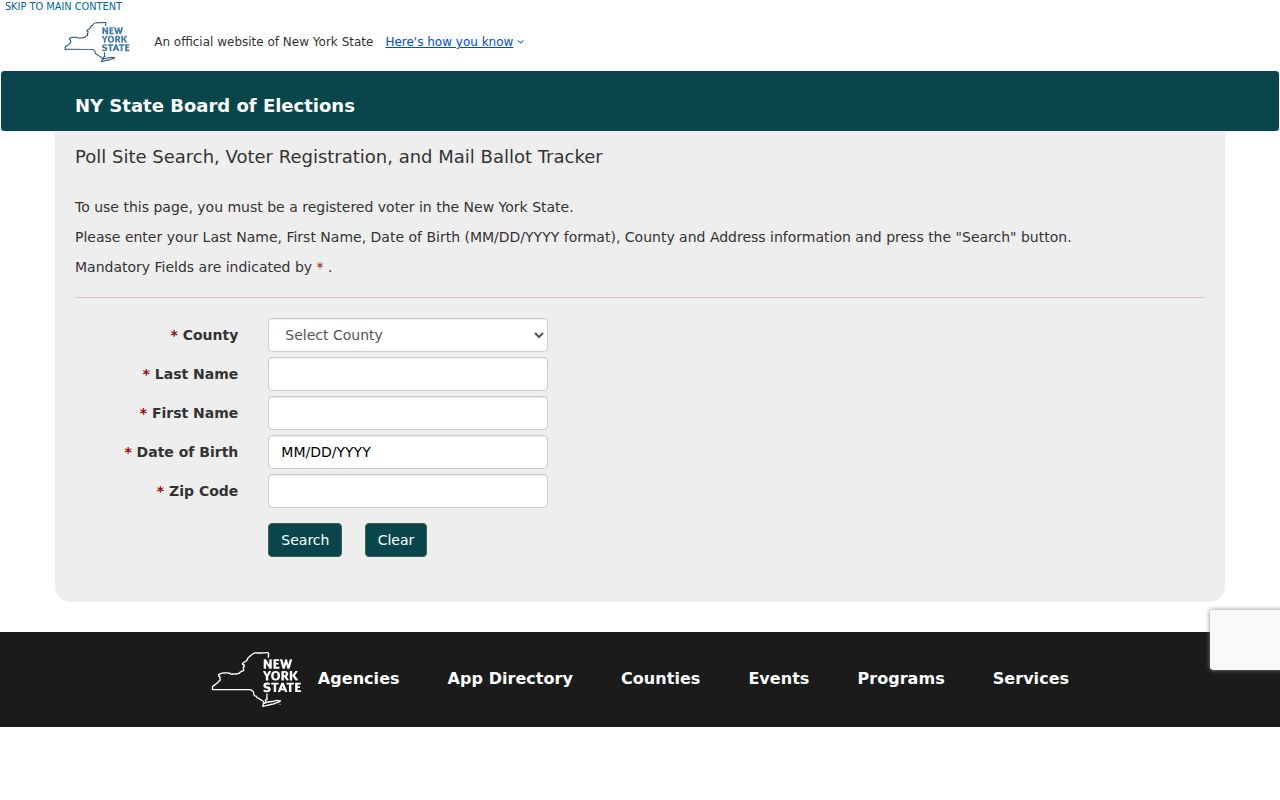
Use a voter result as one identity anchor only after the displayed relationship agrees with a separate parcel, directory, court, or other official record. Full dates of birth, identifying numbers, and protected physical addresses are not ordinary directory fields. For a transaction, update, or cancellation question, the Oneida County Board of Elections is the official local route.
| Voter lookup input | Verification use |
|---|---|
| County and name | Start with Oneida County and retain the exact name spelling. |
| Date of birth | Use only as the portal requires; do not copy it into research notes. |
| ZIP and address | Compare the returned relationship with a separate official record. |
Note: Preserve the name spelling, search date, and the fields that matched before treating two results as the same person.
New Hartford Resident Court Searches
Court records require a portal chosen for the court and case type, not a broad name search alone. NYSCEF Case Search offers guest civil e-file searching by case number or party name and can narrow results by county, type, and filing dates. WebCivil Local and WebCivil Supreme have their own index, party, attorney or firm, calendar, and other tabs. WebCriminal uses case, summons, defendant, and calendar routes with an update-delay notice. Keep a no-result note with the portal, spelling, date range, and coverage rather than asserting that no case exists.
The guest NYSCEF case-search route shows the fields available before a person-specific search is run.
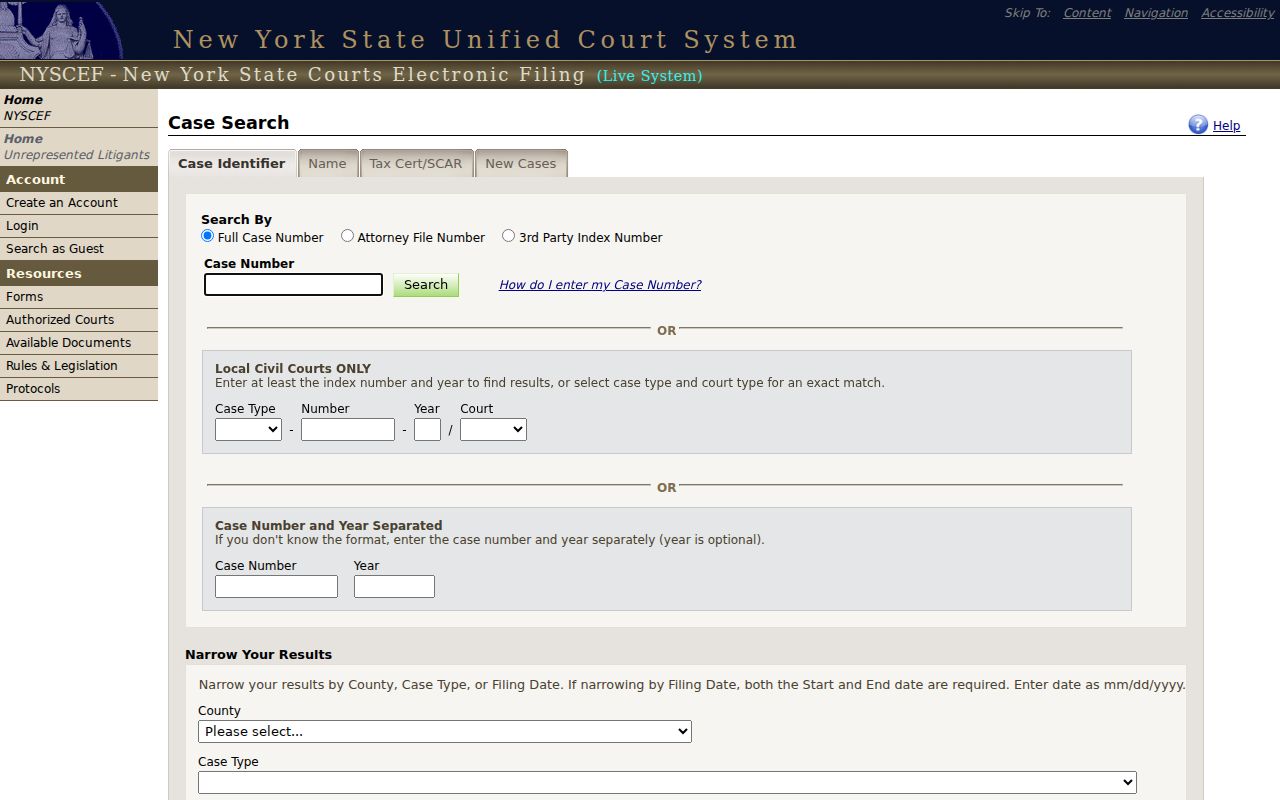
Save the county, case type, index or case number, filing date, party spelling, status, and public document link from a result. That detail lets the clerk locate a specific pleading, order, judgment, or certified copy when one is available.
| NYSCEF search field | Useful verification control |
|---|---|
| Case number or third-party index number | Use when a document already supplies an identifier. |
| Party or name | Test known spelling variants and retain the exact search term. |
| County and case type | Narrow to Oneida County and the appropriate matter. |
| Filing start and end dates | Enter both dates when a time window is known. |
Reading New Hartford Court Results
A public docket is an index to a case, not proof that every name in a result belongs to the New Hartford person under review. Oneida Supreme civil actions from 1992 forward may be searchable through IQS except sealed or confidential matters. Criminal files remain clerk-terminal material rather than an online public search. The clerk terminal can accept a name and timeframe inquiry, which may take up to 24 hours. Oneida Surrogate’s Court is the route for wills, probate, estates, heir proceedings, guardianship, and small estates, but staff should be asked about the exact file and copy access.
A court result that is relevant enough to preserve normally includes the following record inventory:
- court, county, case type, index or case number, and filing date;
- party spelling and any attorney or firm displayed by the portal;
- status, document type, and links to public filings; and
- the portal, date range, and search terms used to obtain it.
Use the court’s terms as they appear in the result, then ask the custodian for the exact document needed. Sealed, confidential, youthful, adoption, and not-yet-recorded matters may not appear publicly, so absence in one interface does not answer every court question.
- Docket
- The court’s case list and event record for a matter.
- Index and image
- An index identifies a record; an image is the document view or copy itself.
- Certified copy
- A custodian-issued copy bearing the court’s certification when that service is available.
New Hartford Vital Record Routes
Birth, death, and marriage records are not ordinary FOIL files. The New Hartford Town Clerk acts as local registrar for the applicable event, while some historic hospital series route through Utica or the New York State Department of Health. The Town’s death instructions cover Town and Village deaths, including Chadwicks and Washington Mills, from 1885 onward. A birth event location should not be assumed to be a home address, and the County Clerk does not hold ordinary vital records.
The New York genealogy route explains the state eligibility and search framework for older events.
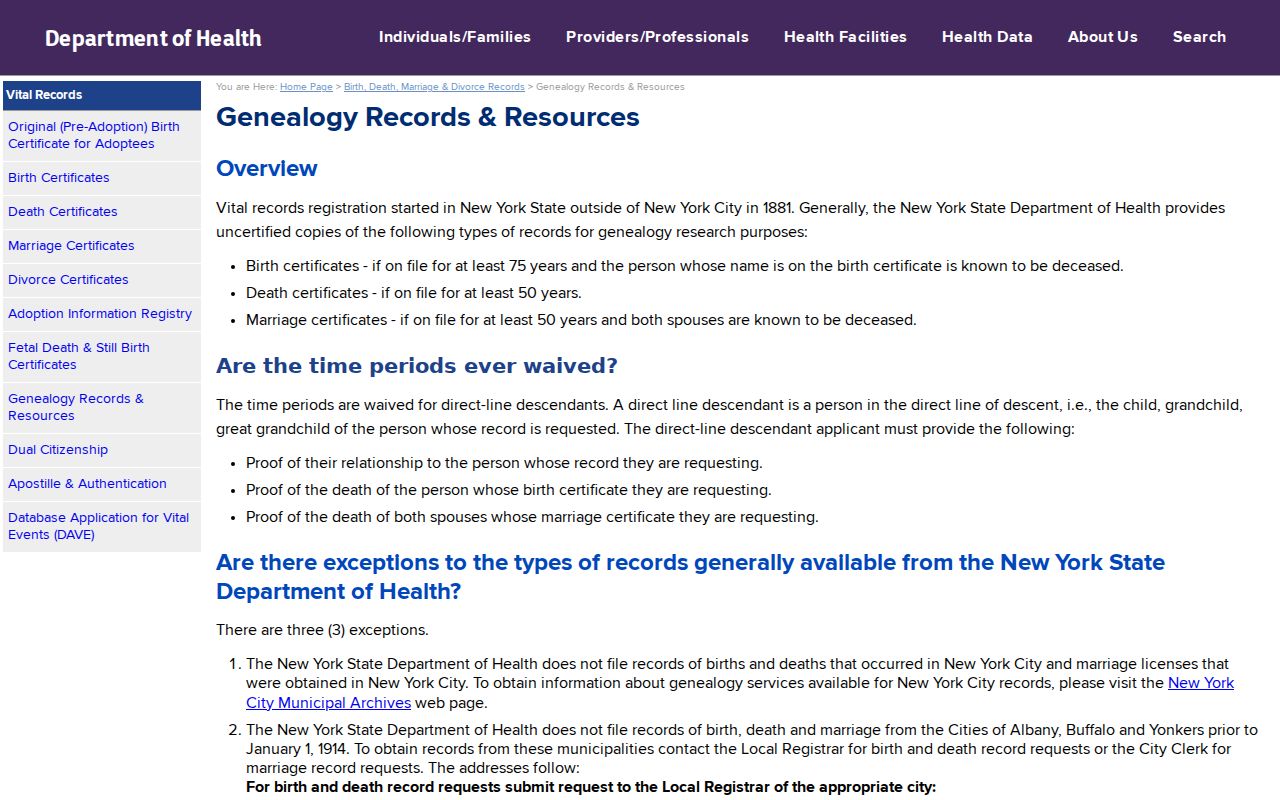
Genealogical access generally requires a birth to be at least 75 years old with the subject known deceased, a death to be at least 50 years old, or a marriage to be at least 50 years old with both spouses known deceased. The local genealogy form asks for the event type, names, date and place, relationship, and supporting death proof. The Town lists a $10 local certificate search and a $22 genealogical search for one to three years, while the state route has its own schedule and processing rules. For local applications, the Town describes paper handling, payment methods, identification, and mail procedures rather than telephone confirmation.
New Hartford Directory Place Labels
Historical verification often turns on place labels rather than a modern street number. The Utica directory series includes New Hartford and nearby places in listed runs from 1869–70 through 1951, with gaps. The 1913 R.L. Polk volume has 902 pages and expressly includes New Hartford and neighboring communities. An entry can contain a name, occupation, business location, street or intersection, residence notation, and an abbreviation such as res, h, or bds. A business location in Utica and a residence in New Hartford are separate facts.
The scanned volumes and their access limits are described through the New Hartford Directory Book. Search New Hartford, New Hartford village, Whitestown, Utica, Deerfield, Chadwicks, and Washington Mills when the time period supports those labels. Preserve the printed place name and page number, then pair the result with a census, church, cemetery, parcel, or deed anchor instead of modernizing the entry by assumption.
Verify a New Hartford Resident
The most reliable resident lookup sequence narrows rather than gathers everything at once. Start with the exact question, such as a current parcel connection, a recorded party, a historical residence, an estate matter, or a professional location. Normalize spelling variants and old place labels first. Then give each source a role. SearchIQS can test a recorded party and legal parcel, the appropriate court portal can test case identity, and directory or genealogy material can place a person in a period. A professional license or entity record may corroborate a professional or organization location, but it is not a general residence source.
- Search the assessment roll or Beacon by name, address, or parcel and copy the situs and mailing fields separately.
- Search SearchIQS by name, date, and town, then record the deed or instrument details without treating a party as an occupant.
- Use the applicable court portal with Oneida County, a date range, and name variants; save the coverage limits along with the result.
- Use the registrar, directory, census, church, cemetery, or newspaper route only for the historical question it can support, then compare two independent anchors.
Keep a log with spelling, middle initial, address, portal, date range, result count, coverage notice, and whether a document is index-only or image-backed. The New York FOIL guidance supplies a written-request fallback for agency records, but FOIL does not override vital-record confidentiality, election limits, court sealing, or protected addresses.
Note: A no-result should be recorded with its source limits, not converted into a conclusion about the person.
New Hartford Resident Lookup Boundaries
New York records include deliberate privacy limits. The Address Confidentiality Program provides a substitute address and mail forwarding, with a four-year membership term stated by the state. Government agencies must accept the substitute address where required, and an actual address is released only through authorized court or law-enforcement process. Confidential voter registration is a separate safeguard. An omitted location can therefore be a correct result, not an incomplete search. Do not try to reconstruct a protected address from neighboring sources.
Keep public record, historical record, live status, and inference separate. Do not reproduce full dates of birth, identifying numbers, signatures, or unrelated household details. Court sealing, vital-record rules, election-purpose limits, FOIL exemptions, and motor-vehicle privacy restrictions all set real boundaries on what can be combined. A professional or business address is also not automatically a home address. When a correction or removal question arises, contact the publisher or custodian that controls the record instead of copying the information elsewhere.
Lawful use. Use a New Hartford resident lookup for personal, lawful research and verification. New York stalking and harassment laws prohibit using identifying or address information to stalk, harass, intimidate, or harm another person.