
New Hartford Previous Resident Sources
For New Hartford previous residents, begin with the era of the question and the strength of the address anchor. A current parcel record is best for connecting today’s address to a parcel number and a deed-book reference. SearchIQS follows the recorded party trail. The Utica-area directory volumes and public census schedules add household and street clues between deed events. Church, cemetery, and newspaper materials can corroborate a residence or family connection, but their local coverage varies and needs an item-level check.
| Source | Years it covers | Where held | What it shows |
|---|---|---|---|
| Current final roll | 2025-26 inspected | Town and Oneida County links | Current parcel-row fields and a deed-book lead. |
| SearchIQS deeds | 1963-present; split at 1974 | Oneida County Clerk | Recorded parties, legal description, and images where available. |
| New Hartford-inclusive directories | 1869-1951 listed runs, with gaps | Utica Public Library and FamilySearch | Name, residence, business or occupation, and street clues. |
| Federal census | 1790-1950 public series | NARA, Census, FamilySearch | Household, age, birthplace, occupation, and street or place context. |
| New York state census | 1825, 1835, 1855, 1865, 1875, 1915, 1925 | State Archives and FamilySearch | Household and location context; 1845, 1892, and 1905 are lost. |
| Church, cemetery, newspaper | Local runs vary | Historical Society, History Center, churches, libraries | Relationship, death, residence, and place corroboration. |
The Oneida County Clerk’s public-records route provides online access, public terminals, and copy information. When an older record is absent online, use the terminal, a written request, or the repository that holds the historical material instead of treating the gap as a negative result.
New Hartford Parcel Starting Points
A backward address trail should start from the current parcel number, not from an unverified surname. The Town Assessor directs researchers to Beacon and the published rolls. Record the situs address separately from the current owner’s mailing address, then save the parcel ID, class, acreage or grid clue, and deed-book reference. The County GIS viewer confirms the parcel’s road position and neighboring geometry. Those details are especially important when a historic instrument uses a legal description or a different place name.
The 2025-26 final roll shows why this separation matters. It can include the property address, owner, mailing address, assessment class, values, exemption fields, acreage or grid, and a deed book or page. It does not establish who lived at the property. A municipal owner or a mailing address outside the Town may be entirely consistent with the parcel record. Preserve exactly what the roll says before moving to the recorded deed.
The County Clerk copy-request form is available when a known document needs to be ordered or identified by party, liber and page, file, or index number.
A focused request should include the town, date range, parties, parcel, and liber or page when known, rather than ask for a broad list of past residents.
New Hartford Deed Chain Steps
The Oneida County SearchIQS index is the deed-chain route. It supports party, date, document, town, book or page, instrument or case, and party-type controls. The County public-record legend reports deed index and data from 1963 through 1974, then index and image coverage from 1974 forward. Use that transition as an access note, not a claim that the chain begins in 1963. Older material may require a public terminal, the Clerk, or a defined written search.
- Pull the current parcel’s owner, situs, parcel ID, and deed-book lead from Beacon or the final roll.
- Find the known transfer in SearchIQS by party, town, date range, document type, or book and page.
- Record the grantor, grantee, recording date, instrument number, legal description, liber or page, and whether an image is available.
- Search the seller as a grantee to locate that person’s earlier acquisition, then compare the legal description and parcel clues.
- Repeat backward. If a parcel number changes, bridge the gap with acreage, road, neighboring owners, map geometry, and the legal description.
- Grantor
- The party who transfers an interest in a recorded deed.
- Grantee
- The party who receives that recorded interest. A grantee search can reveal an earlier purchase.
- Chain of title
- The sequence of recorded transfers connected through parties and the same property description.
- Legal description
- The land description in an instrument. It is often a steadier historical anchor than a street number.
Use the County Clerk’s deed instructions when an index hit needs a copy or image.
The deed chain establishes recorded transfers. Past residents may include people who were not deed parties, so the next step is household evidence.
New Hartford Previous Resident Gaps
Document every break in a New Hartford previous residents trail. A result can be index-only, missing an online scan, filed under a different town label, tied to a changed parcel, or held by another custodian. Keep a log of search terms, spelling, year range, record type, portal, image status, and the original place label. A no-result in one system is not evidence that a transfer or household never existed.
Search alternate place labels when the address is older. New Hartford separated from Whitestown in 1827, while Utica annexations in 1921, 1922, and 1925 affected later municipal labels. Test New Hartford, Utica, Whitestown, Deerfield, Washington Mills, and Chadwicks with the road name. An official New Hartford street-renumbering schedule was not located, so historic street sections, census street order, cemetery or church descriptions, legal descriptions, and historic maps are better evidence than a forced number match.
Oneida County has been digitizing records since 2023, obtained a map scanner in 2024, and added Deeds staff. Coverage can change, so preserve the date checked and whether access was online, at a terminal, or request-only.
Start an online recorded-instrument search at the SearchIQS guest entry.
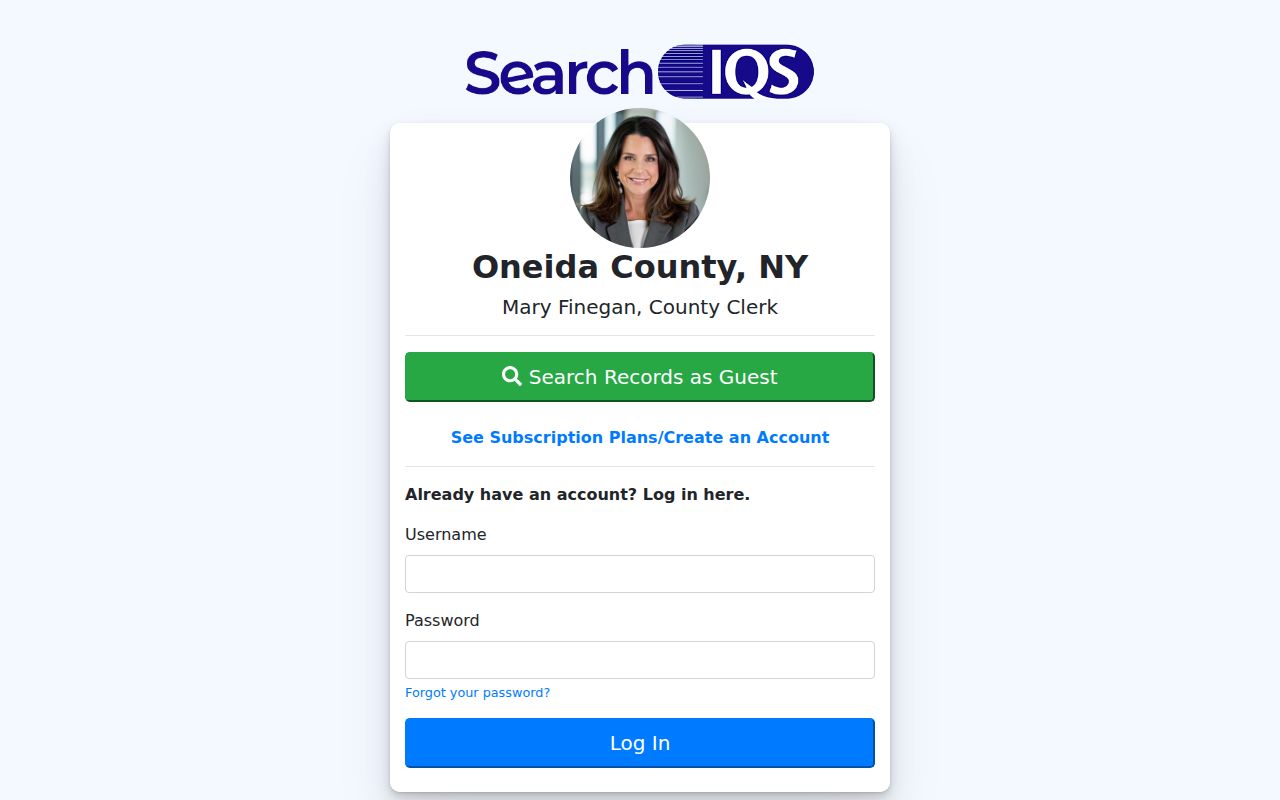
The coverage legend helps decide whether an indexed deed should lead to an image, a copy request, or a County Clerk counter search.
New Hartford Previous Resident Households
Directories and census schedules supply the household layer that deeds cannot. The Utica Public Library directory gateway lists New Hartford-inclusive runs from 1869-70 through 1951, with gaps. The gateway is a scan list in progress, not proof that every page is indexed. No separately catalogued New Hartford-only reverse or criss-cross run was found. For an address-first search, use the street and address sections in the Utica volumes, then verify the page against the scan. The New Hartford Directory Book has the collection-focused detail.
Pair each directory clue with the closest available census. Federal schedules are generally public through 1950. New York state census years for Oneida County include 1825, 1835, 1855, 1865, 1875, 1915, and 1925, while 1845, 1892, and 1905 are reported as lost. Preserve the street, household members, age, birthplace, and the original town or village label. A directory can show a business in Utica and a residence in New Hartford, so read the residence notation rather than treating every printed street as a home.
- Choose a directory year between two deed events and search the surname, street section, and relevant place labels.
- Save the printed title, publisher, edition year, page, section, spelling, street or intersection, and residence notation.
- Check the closest federal or New York state census for the household, street order, age, birthplace, and municipality.
- Reconcile conflicts with the deed legal description and map context, then mark uncertain matches as unresolved.
Open the 1913 FamilySearch directory to inspect a digitized New Hartford-inclusive sample.
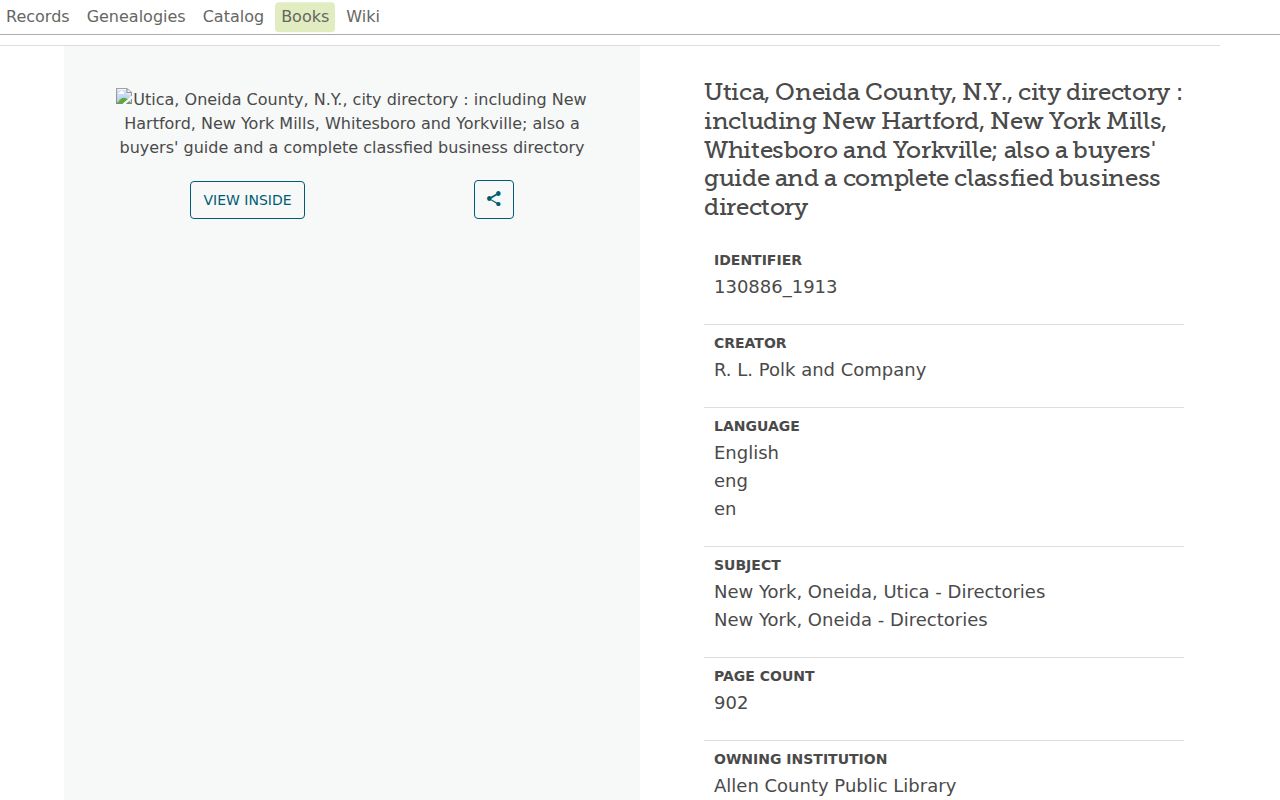
The R.L. Polk and Company volume has 902 pages and includes New Hartford, New York Mills, Whitesboro, and Yorkville, which makes its printed place label essential evidence.
Note: A directory residence notation is a period clue that should be compared with its scanned page and the nearest census schedule.
New Hartford Previous Resident Archives
Use family and local-history material to test a past household after the parcel, deed, directory, and census trail is assembled. The Oneida County History Center holds newspapers, manuscripts, artifacts, images, deed and directory context, and links to NY Heritage and the New Forest Cemetery collection. The County Clerk genealogy page also points to deeds, mortgages, newspapers, directories, and regional research referrals. Ask for the collection title, date span, geographic scope, page or item identifier, and whether a result is an original, scan, transcription, or index.
For obituary and cemetery work, a dedicated New Hartford obituary index was not located in the official library pages. The practical substitutes are library databases, County History Center newspaper holdings, church sources, and cemetery collections. Search a surname with a road, mill, church, school, or property term. The New Hartford Historical Society and the State Archives are further routes when a historic address is connected to a hamlet, early land history, church, or county archival material.
Explore the Oneida County History Center research library for the regional source routes that can corroborate a household trail.

Historical repositories add context to a documented address trail, while the recorded deed and parcel files remain the authority for the land record itself.
New Hartford Previous Resident Maps
Maps can help reconcile a road or number that changed, but they should be used with care. The Library of Congress guide supports searching Sanborn fire-insurance maps by state, city, date, sheet, and notes. No New Hartford, New York edition was located in that search. A Clinton 1904 map and nearby Utica maps offer contextual clues only, not a substitute for a New Hartford address record. Record the map title and exact sheet before using a building footprint in a house-history file.
The stronger combination for a New Hartford address is legal description for land, assessment roll for tax parcel, map for geometry, directory for people or street context, census for household, and church, cemetery, or newspaper sources for relationships and events. Each was created for a different purpose. Two independent source types are more useful than one detailed but uncorroborated entry.
New Hartford Previous Resident Limits
Previous residents research should not collapse owner, occupant, mailing recipient, recorded party, and household member into one label. The assessment roll may identify a current owner whose mailing address is elsewhere. A deed records a transfer. A directory can reflect a residence, boarding arrangement, business, or intersection. A census is a dated household snapshot. Protected addresses, sealed records, incomplete scans, and place-name changes can all produce a legitimate gap.
New York’s Address Confidentiality Program supplies a substitute address and mail forwarding for eligible participants, and confidential voter registration is a separate safeguard. Preserve a protected address exactly as labeled and do not try to derive an underlying location. Limit the work to house history, family history, heir research, and personal curiosity, while keeping unnecessary personal details out of the notes.
Lawful use. New Hartford previous residents research is for responsible house and family history. Do not use records to track, stalk, harass, intimidate, or harm a living person.